The slowdown of circular plastics in Europe threatens the green transition
Translation of the special content on the Circular Economy report in national Spanish daily ABC
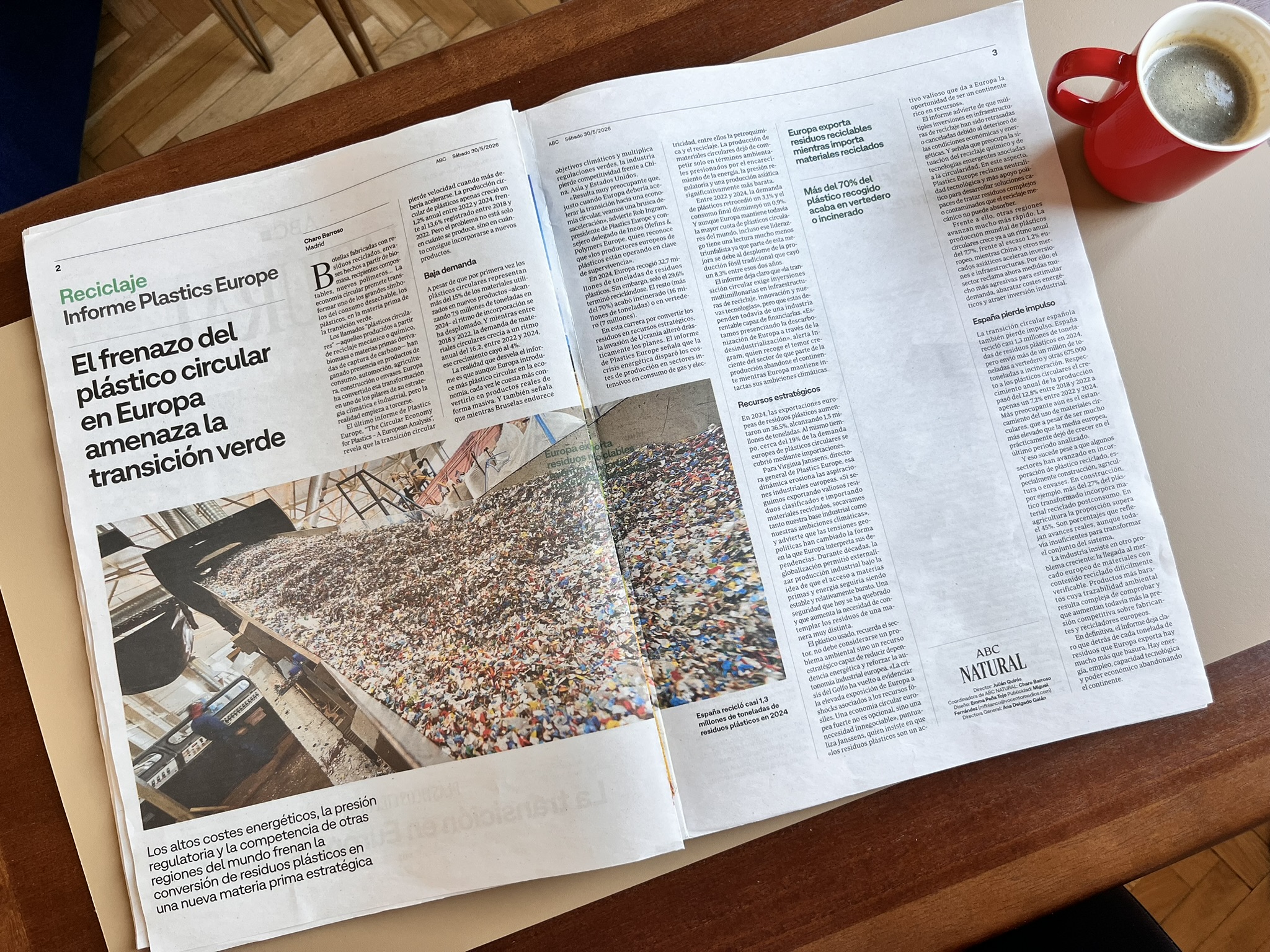

By Charo Barroso, Madrid May 30 2026
Recycling. Plastics Europe Report
Bottles made from recycled waste, packaging produced from biomass, compostable containers, new polymers… The circular economy promises to transform plastics—one of the great symbols of disposable consumption—into the raw material of the green transition. So-called “circular plastics” — those produced from mechanical or chemical recycling, biomass or carbon capture-derived feedstock — have gained a presence in consumer goods, automotive, agriculture, construction and packaging. Europe has made this transformation one of the pillars of its climate and industrial strategy, but reality is beginning to turn.
The latest Plastics Europe report, “The Circular Economy for Plastics – A European Analysis”, reveals that the circular transition is losing pace just when it should be accelerating. Circular plastics production grew by only 1.2% per year between 2022 and 2024, compared with 13.6% between 2018 and 2022.
However, the issue is not only how much is produced, but how much is actually incorporated into new products.
Declining demand
Despite circular plastics representing more than 15% of the materials used in new products — reaching 7.9 million tonnes in 2024 — the rate of uptake has collapsed. While demand for circular materials grew by 16.2% annually between 2018 and 2022, it fell to just 4% between 2022 and 2024. The report shows that although Europe is introducing more circular plastics into the economy, it is increasingly difficult to convert them into real products at scale. It also highlights that while Brussels tightens climate targets and multiplies green regulations, the industry is losing competitiveness against China, Asia and the United States.
“It is very worrying that, just when Europe should be accelerating the transition towards a circular economy, we are seeing a sharp slowdown,” warns Rob Ingram, President of Plastics Europe and CEO of Ineos Olefins & Polymers Europe, who acknowledges that “European plastics producers are operating in survival mode.”
In 2024, Europe collected 32.7 million tonnes of plastic waste. However, only 29.6% was recycled. The rest — more than 70% — was either incinerated (16 million tonnes) or landfilled (7 million tonnes). In the race to turn waste into strategic resources, the invasion of Ukraine dramatically altered plans. The Plastics Europe report notes that the energy crisis sharply increased production costs in gas- and electricity-intensive sectors, including petrochemicals and recycling. Circular materials are no longer competing solely on environmental terms, facing instead the pressure of higher energy costs, regulatory burdens and significantly cheaper Asian production.
Between 2022 and 2024, demand for plastics fell by 3.1% and final consumption decreased by 0.9%. And although Europe still holds the largest share of circular plastics globally, this leadership is less positive than it appears, as part of this improvement is due to the collapse in traditional fossil-based production, which fell by 8.3% over the same period. The report makes it clear that “the circular transition requires multi-billion-euro investments in recycling infrastructure, innovation and new technologies”, but these still depend on a profitable industry capable of financing them. “We are witnessing Europe’s decarbonisation through deindustrialisation,” warns Ingram, reflecting growing concerns that part of production may leave the continent while Europe maintains its climate ambition.
Strategic resources
In 2024, European exports of plastic waste increased by 36.5%, reaching 1.5 million tonnes. At the same time, nearly 19% of European demand for circular plastics was met through imports. For Virginia Janssens, Managing Director of Plastics Europe, this dynamic undermines Europe’s industrial ambitions. “If we continue exporting valuable sorted waste and importing recycled materials, we undermine both our industrial base and our climate ambitions.” She also stresses that geopolitical tensions have changed how Europe views its dependencies.
For decades, globalisation enabled industrial production to be outsourced under the assumption that access to raw materials and energy would remain stable and relatively affordable. That certainty has now been broken, increasing the need to view waste in a very different way. The sector emphasises that used plastics should not be seen as an environmental problem but as a strategic resource capable of reducing energy dependence and strengthening Europe’s industrial autonomy.
The report warns that multiple investments in recycling infrastructure have been delayed or cancelled due to the deterioration of economic and energy conditions. It also raises concerns about chemical recycling and emerging circular technologies, calling for technological neutrality and greater policy support. Meanwhile, other regions are moving much faster. Global production of circular plastics is already growing at an annual rate of 7.7%, compared with Europe’s modest 1.2%, while China and other Asian markets accelerate investment and infrastructure. The sector is therefore calling for much more ambitious measures to stimulate demand, reduce energy costs and attract industrial investment.
Spain loses momentum
Spain’s circular transition is also losing momentum. In 2024, Spain recycled almost 1.3 million tonnes of plastic waste, but sent more than one million tonnes to landfill and a further 675,000 tonnes to incineration. Growth in circular plastics production fell from 12.8% (2018–2022) to just 7.2% (2022–2024). Even more concerning is the stagnation in the use of circular materials, which, despite being higher than the European average, has barely grown in the most recent period analysed.
Some sectors have made progress in incorporating recycled plastics, particularly construction, agriculture and packaging. In construction, more than 27% of processed plastic includes post-consumer recycled material, while in agriculture this share exceeds 45%. These figures reflect real progress, although still insufficient to transform the entire system.
The industry also points to a growing problem: the arrival on the European market of materials with recycled content that is difficult to verify, putting additional competitive pressure on European manufacturers and recyclers.
In short, the report makes clear that behind every tonne of waste Europe exports there is far more than rubbish: there is energy, employment, technological capacity and economic power leaving the continent.